What happens if overcrowded Early Childhood Development (ECD) schools had access to well-resourced reading clubs and if local organisations received sustained funding to expand their supplementary learning programmes?
The truth is, most ECD schools in refugee settings across Uganda’s West Nile region are nowhere close to that reality. Overcrowding undermines the quality of learning and weakens the educational foundation of ECD learners. A small number of caregivers across most community-led schools are responsible for managing far too many learners, an imbalance that compromises service delivery. Only a few parents, typically those with relatives living abroad, are able to support their children’s education in better-resourced schools in urban towns like Arua and Koboko, and fewer still can afford to send their children to schools in Kampala. The majority of families rely on under-resourced community schools, where limited resources and overcrowded classrooms continue to constrain learning.
Recent funding cuts have hit communities hard: many trained caregivers have left their positions, affecting the quality of service, and those still there rely on modest community support. These challenges leave many children without the individual attention so clearly needed during the formative years. Youth for Peace Initiative – Uganda, a locally led organisation in Lower Rhino camp settlement, Ocea zone, in northern Uganda, is – together with other actors in the region – demonstrating how community-led initiatives play a crucial role in bridging learning gaps. Many such initiatives have established reading clubs, giving learners the chance to improve their literacy, self-confidence, and love of lifelong reading outside the classroom.
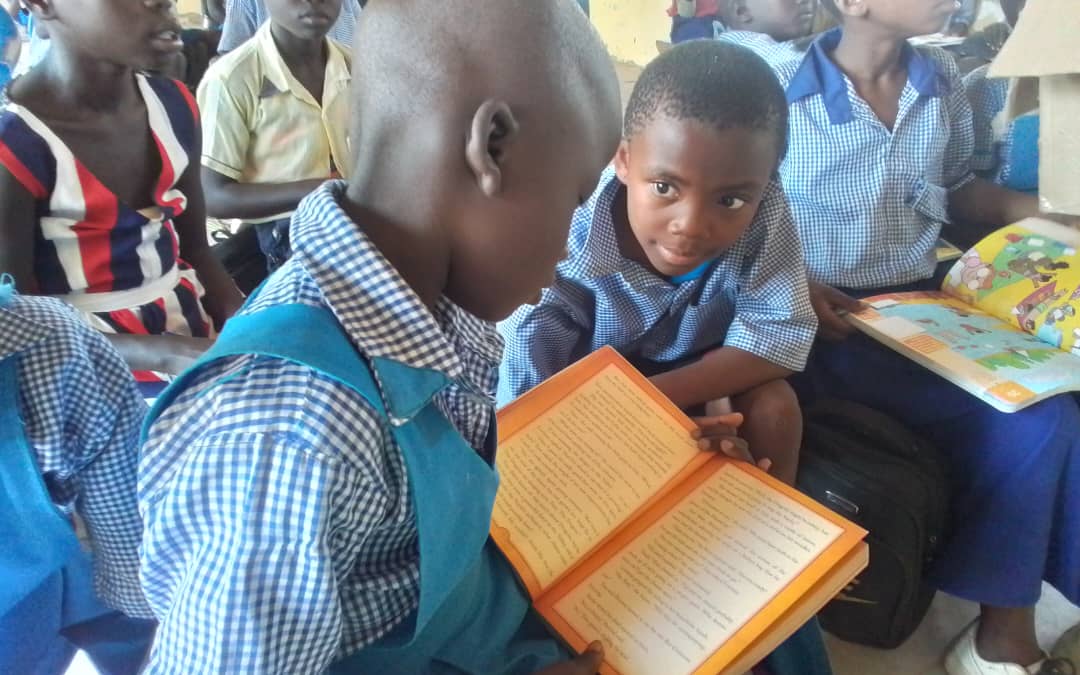
During an informal visit to a school reading club established by Youth for Peace Initiative Uganda, I came across the inspiring stories of two learners benefiting from the club’s supplementary learning programme. I learned how access to reading materials, mentorship, and supportive learning environments beyond the normal classroom can strengthen children’s literacy skills, confidence, and overall academic development. Both learners now read with ease and confidence, their passion for reading keeps growing, and their story makes a compelling case for sustained community investment.
Although Youth for Peace Initiative Uganda is making innovative use of locally available materials to support its supplementary learning programmes, they continue to operate under significant resource constraints in delivering the same service across six early childhood development centres in Ocea zone. The reading clubs have fewer books than the growing number of learners they serve, and the persistent funding gap clearly hinders the expansion and sustainability of these initiatives.
Similarly, Youths Empowerment Network in Imvepi (YEN) reorganised an ECD school that had closed after aid support vanished, engaging parents to help bring it back. The school is now functional and sustained through community support, and YEN’s work continues to rebuild hope in the community while proving that local solutions can be both effective and sustainable. Their story has raised awareness among many stakeholders and, in doing so, has won the community’s trust in the relevance of local interventions.
Allvox, a local organisation working in Imvepi refugee settlement, believes that play is a fundamental component of learning for pre-primary children. In partnership with ECD caregivers and parents, the organisation promotes the use of locally made teaching and learning materials to enrich children’s learning experiences. With the help of locally available materials, caregivers and parents produce a variety of educational materials, including balls, alphabet cards, number cards, letters, and picture cards, among other play-based learning aids, and the approach is being received positively, with full support from parents and caregivers. To further engage the children, Allvox has produced a 34-minute recorded audio programme designed to maximise learning for pre-primary children, broadcast through installed community radios to reach its intended audience.
WARDI, with support from Ubongo Kids‘ Reading Content, is instilling learning in pre-primary children through recorded audio and visual educational materials. These lessons are presented in simple phrases and age-appropriate language suited to these learners. This learning strategy not only shapes learners’ ability to learn, but also creates a space for children to gather and interact inclusively within the community.
…the success of community-led initiatives is a clear example of how local organisations possessing the commitment, innovation, and trust are needed to deliver effective and sustainable education solutions.
Women Concern and Idea and The Refugee Voice in Bidibidi are working all-round within their means to give back to the community at this critical moment when support has dwindled, and their stories of reimagining hope for nearly collapsed pre-primary facilities echo those of the other partners.
In conclusion, the success of community-led initiatives is a clear example of how local organisations possessing the commitment, innovation, and trust are needed to deliver effective and sustainable education solutions. Through reading clubs, locally produced learning materials, play-based learning approaches, and audio-visual content, local actors in the West Nile region are not only filling the gaps left by the collapse of aid support, but are also building resilience and sustainable, community-owned models of learning.

Leave a Reply