
Some trips give you photographs. Others give you a story to tell for the rest of your life.
My recent trip to Malawi did both, but more than anything, it touched my heart. It reminded me that there are still places in this world full of good people who hold on to their culture, their dignity, and their love for one another even when they have almost nothing else.
I travelled with my colleague Joseph. Our mission was simple to state but harder to feel confident about: to visit the Dzaleka refugee community, to sit with refugee leaders, to listen to how they are doing their work, and to understand how we as an organisation can best walk alongside them.
The Doubt We Carried
I will be honest. We set off carrying a lot of doubt.
We had gone a long time without hearing back from the groups that we were meant to meet with . We did not know where to begin, or whether we would even accomplish what we had set out to do. That kind of silence can make you question everything. Will they welcome us? Will the mission fall apart before it starts? Will we have made this journey for nothing?
So, we did the one thing that changed everything. We reached out to a single refugee leader and asked for his help in connecting us with the refugee-led organisations on the ground.
His response melted the doubt away. He was genuinely excited that Cohere was coming to Malawi. And when we arrived, we were amazed by how much he had coordinated to support our trip. That was my first lesson of the trip. The people of Dzaleka are not sitting still, waiting for someone to save them. They are already building, they are looking for opportunities, ready to collaborate and already leading.
The Leader Who Showed Us the Way
If I were ever asked to give an award to a leader, I would start with him.
What impressed me most was not just how well he had planned everything. It was his choice of where to take us first. He made sure that before anything else, we visited the most marginaliszed members of the community, the people doing their work quietly, with passion and love, expecting nothing in return.
That decision told me everything I needed to know about the kind of leader he is. His love for his community is the sort of thing that rarely gets recogniszed, and it deserves to be. I wish everyone could have the chance to meet those communities the way we did. They would understand why this trip changed me.
We Didn’t Want to Leave
We spent seven days in Dzaleka, and by the end, we did not want to leave. We wished we could stay another week, or even another month The reason was the people. The refugee leaders in Dzaleka are some of the warmest human beings I have ever met. They are deeply passionate about their work, and the love they carry for their community is, quite honestly, underrated. We met a good number of them, women, men, and youth alike, and every single one of them was exceptional.
If you had told me at the start when I was still full of doubt that I would end the trip feeling this way I might not have believed you. But that is exactly what happened.
A Camp Unlike My Own
Here is what makes this trip personal for me as a refugee. I lived in Rwamwanja, and sometimes I catch myself thinking I have seen it all. Malawi changed my perspective entirely.
Dzaleka is a large camp, but it is severely overpopulated. It was originally designed to host between 10,000 and 12,000 refugees and asylum seekers. Today it is home to more than 64,000 displaced people and more are arriving everyday. That overcrowding has stretched everything past its limit like facilities, infrastructure, basic services, all of it. There is so little space that people are now constructing homes on top of a cemetery because there is simply nowhere else to build and I had never witnessed anything like it.
When I saw it immediately my mind went straight back to my childhood. Growing up we were so afraid of cemeteries that we would not even go near one, and if I am honest, that fear has never fully left me. Even now as an adult it is still there. To stand in Dzaleka and watch people build their homes right on top of the graves not because they wanted to but because they had no other choice left me completely speechless. That is what desperation looks like when survival takes away even the fears you were raised with.
And I realised that no matter how much I think I understand about refugee life I still have a long journey of learning ahead of me. I am sure I am not the only one who sometimes assumes they have already seen the worst of it.
When I say there is no space, I do not only mean space for houses, I mean there is no land to farm. When people in Dzaleka want to cultivate, they must rent or buy land from Malawians, something completely different from my experience back in Rwamwanja. It is however, the same challenges refugees in the West Nile settlements are facing. On top of that Malawi itself faces a hard reality – the country has only one growing season a year. Imagine what that means for refugees who are already stretched to their limit, trying to feed their families with so few options.
Seeing all of this, the overcrowding, the graves, the single season, the struggle just to grow food, I finally asked some of the refugees a question. I knew even as I said it that it might sound silly, but I was so overwhelmed by everything I was seeing that I could not hold it back and I asked, “ Why did you come to this camp when there are other camps you could have gone to?”.Their answer came without a moment’s hesitation, that they were looking for safety, that was all. Many of them, mostly from the Democratic Republic of Congo and Rwanda, had crossed two borders searching for a place where they could simply be safe. And that answer silenced me, these families had not chosen this hardship, they had fled something far worse than Dzaleka. Despite its overcrowding and hunger, it was still the safer place for them.
“They have agency. They are already deciding, already organising, already leading their own communities long before any of us arrived. They know their needs, their strengths, and their neighbours better than any outsider ever could. Our role is not to walk in with a ready-made plan and hand it to them. Our role is to strengthen the agency they already carry to follow their direction not to override it. When support respects that it lasts. When it ignores it, it fails. We have seen it time and time again.”
What They Actually Need
And yet,they are not defeated. The people of Dzaleka are ready to build from scratch.
They have the will, the passion, and the love. What they need from us, as their partners, is not complicated.
They need us to listen.
They need us to support them.
They need us to show up and prove that we believe in them.
And here is something I want to say clearly, the people of Dzaleka are not waiting to be rescued.
They have agency. They are already deciding, already organising, already leading their own communities long before any of us arrived. They know their needs, their strengths, and their neighbours better than any outsider ever could. Our role is not to walk in with a ready-made plan and hand it to them. Our role is to strengthen the agency they already carry to follow their direction not to override it. When support respects, that it lasts. When it ignores it, it fails. We have seen it time and time again.
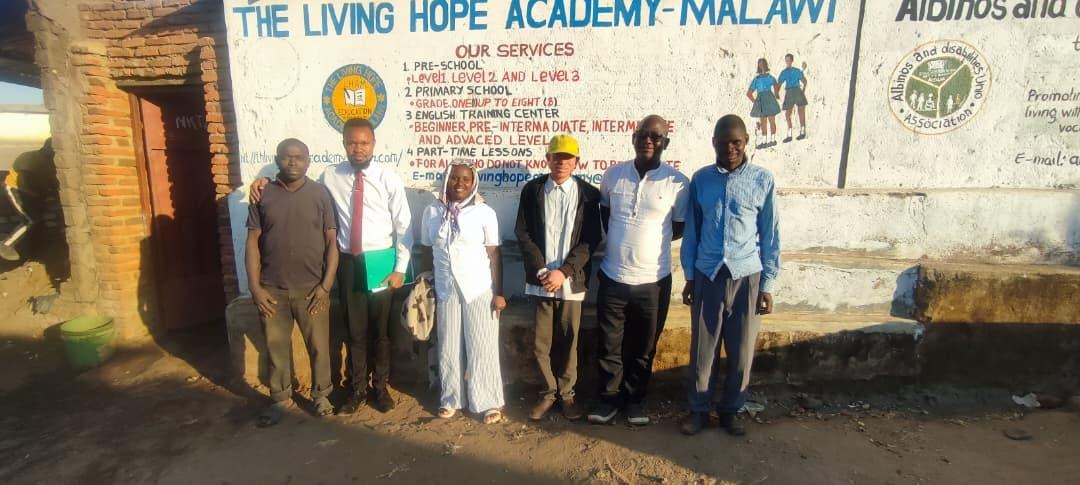
Let me give you one example of what that agency looks like. We met a refugee leader who has spent six years advocating for protection and basic rights for his fellow people living with albinism, a community that faces particular danger and discrimination. His commitment paid off. Through his advocacy, a good number of them were granted protection through resettlement. For those still in the camp, he built a simple school called The Living Hope Academy to help their children learn, and he provides basic necessities that most people never think about, lotion, umbrellas, and sunglasses, the things his community needs to stay safe under the sun.
He has done all of this without any funding.
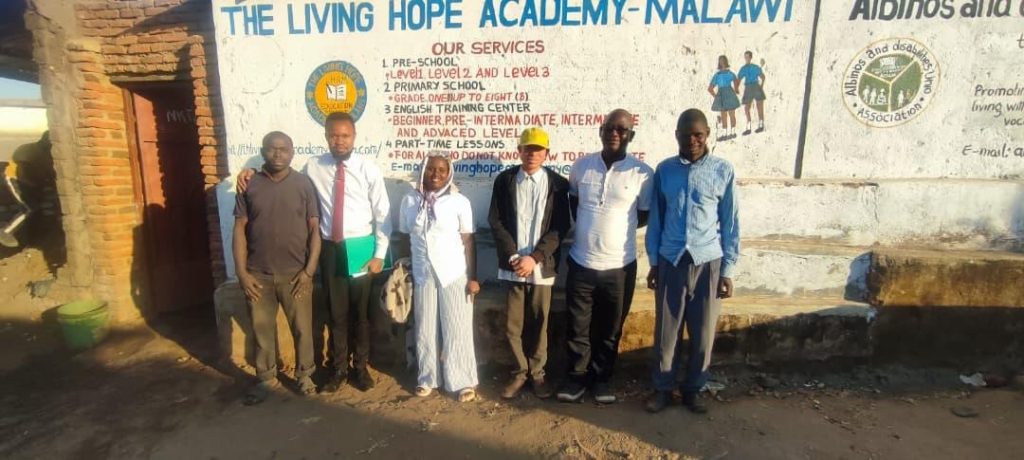
Outside The Living Hope Academy in Dzaleka, the school built for children in the albinism community
I remember looking at some of the books he used to teach. The rain had gotten to them, and some of the words had washed away completely. But what struck me was how happy he was just to have those books at all. He told me they were helping him teach the children. Those damaged, half-legible pages were treasures to him. If you want evidence of why refugees need agency over their own lives, look no further than this man, building The Living Hope Academy, saving lives, and teaching children with rain-soaked books and no budget, driven by nothing but love and determination. And this is just one of many examples.
Yes, money matters. Funding can extend and build and grow our activities, and I will never pretend otherwise. But do you know what it means to simply show up for people in need, before anything else? To sit with them, to hear them, to let them know they have not been forgotten?
That is the question I keep turning over in my mind. I think showing up is where everything begins. Before the funding, before the projects, before the plans, there is the simple, powerful act of being present. And showing up first is really an act of respect. You listen before you act because the people you are serving are the true experts on their own lives.
My Take away
I left Malawi with more than I brought, another story to tell, another lesson learned and a heart that was somehow both broken and filled at the same time.
To the refugee leaders of Dzaleka, thank you for your warmth, your passion, and the love you pour into your community every single day. You are inspiring and unforgettable.
And to everyone reading this, what do you think it means to show up for people in need before anything else?
Leave a Reply