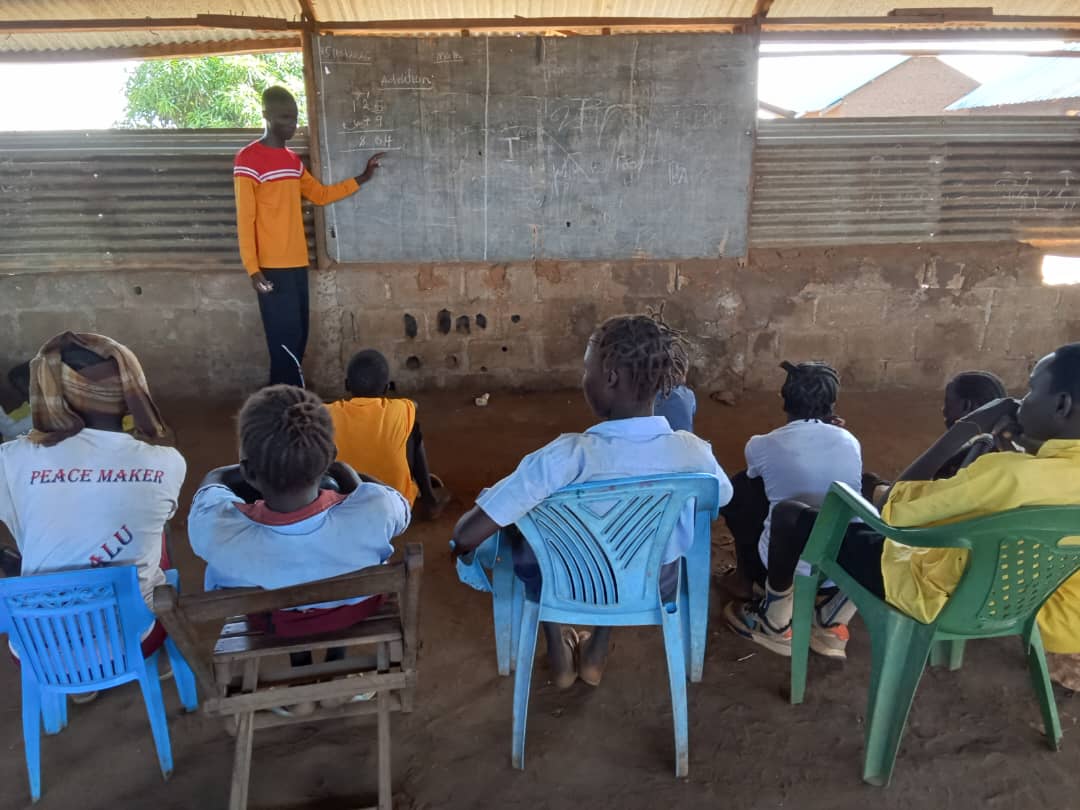
In a temporary classroom made of iron sheets, wooden poles, and bare ground, South Sudanese returnees, internally displaced children, and Sudanese refugee learners sit quietly, focused on their teacher. They are determined to learn with passion and curiosity despite the harsh environment surrounding them. Yet today, hundreds of these learners remain at risk of dropping out of school as they struggle to overcome the many challenges that continue to arise.
This is not because they lack the desire to learn, but because they lack the basic resources needed to remain in school. Parents struggle to put food on the table, and basic educational requirements are often a heavy burden. Rescue and Relief Mission, Cohere’s partner refugee- and IDP-led organisation in Yei, Central Equatoria State in the Republic of South Sudan, is making strides through advocacy efforts to mobilise support and enhance learning opportunities for these highly motivated learners.
Rescue and Relief Mission, informed me that during a recent field assessment of their community that approximately 1,700 school-aged refugee, returnee, and internally displaced children are affected by limited access to adequate educational support.Both in terms of materials and service delivery. Of those assessed, 920 are boys and 780 are girls. Many continue to face challenges such as overcrowded classrooms and long distances to reach school.
As organisations continue to work with vulnerable communities across the state, the pressure on them remains extremely high, as they are often seen as the only source of assistance. Within a constrained funding landscape, Rescue Relief Mission remains committed to restoring hope for these young but determined children by helping build a stronger foundation for their future.
Learners are often seen walking barefoot, wearing a mixture of clothing referred to as uniforms, which do not necessarily reflect a clear school identity. At the same time, teachers continue to make sacrifices to educate these learners despite receiving very low pay and limited allowances.
Such a challenging environment is not only risky for learners, teachers, and social workers, but it is also traumatic, particularly given the limited access to therapy that could support emotional healing and improved mental health for all. From my observation, only a few donors are willing to invest resources in such environments to create meaningful impact for communities across sectors such as education, protection, health, WASH, livelihoods, and others. This highlights the urgent need to directly support the work of impactful actors such as Rescue Relief Mission in the region.
Experiences from partnerships with refugee- and IDP-led initiatives such as Roots of Generations (RoG), ICAN South Sudan, and Youth Advocacy for Peace and Development (YAPD) in conflict-affected parts of the country tell a different story. These projects have already demonstrated meaningful impact within their communities. With the right resources and partnerships, organisations like Rescue Relief Mission and others in the region can significantly improve opportunities for the communities they serve.
Similarly, in Gorom Refugee Camp, approximately 27 km from Juba town, the education situation remains challenging, with an overwhelming number of learners and heavy congestion in classrooms. Inadequate support for teachers’ salaries from both the government and partners running schools has become a serious demotivating factor that affects the learning process.
A member of Cohere’s West Nile Trust Circle Advisory Panel based in Juba, South Sudan, frequently visits Gorom and shares the following observation:
” At Cohere, we cultivate a relationship based approach grounded in trust and believing that through these partnerships, we are engaging in a genuine service to the communities we aim to support. “
“Education in Gorom Refugee Camp is operating under significant strain due to a critical lack of resources, both human and material. In the primary schools, a core group of 31 salaried teachers and 15 incentive-driven volunteers are responsible for a large pupil population, resulting in very high pupil-to-teacher ratios.
This imbalance is worsened by a severe shortage of essential supplies. Textbooks are not available for each pupil, making it difficult for students to follow lessons effectively, and there are not enough exercise books for them to complete their work.
The infrastructure itself also presents barriers to learning. The lack of adequate seating forces four to five students to share a single bench, creating an uncomfortable and distracting environment. In addition, the absence of a library means students have no access to a quiet space for reading or a collection of books to support their learning.”
Morobo County in Central Equatoria State, located near the borders with Uganda and the Democratic Republic of Congo, faces similar challenges. Due to its accessibility and geographical location, the county continues to receive a growing number of returnees from Ugandan refugee settlements such as Bidibidi, Imvepi, and Rhino Camp, as well as from settlements such as Biringi in the Democratic Republic of Congo.
As a result, the education sector in Morobo County is under significant pressure, with limited infrastructure available to support effective learning. South Sudan Relief Foundation, a local community-based organisation, frequently reports on these challenges through its social media platforms.
According to South Sudan Relief Foundation (SSRF):
“Although education activities continue across the county, many schools operate under limited infrastructure conditions. Some schools have basic classroom structures, while others rely on temporary learning shelters constructed by community members using locally available materials.
These makeshift structures often provide minimal protection from weather conditions, disrupting learning and affecting the overall quality of education delivery.
The education system in Morobo County also faces additional structural challenges, including a shortage of trained teachers, heavy reliance on volunteer educators, low teacher remuneration, and insufficient classroom facilities. Furthermore, the county has very limited presence of education and protection partners, leaving many schools without adequate institutional support.”
At Cohere, we cultivate a relationship based approach grounded in trust and believing that through these partnerships, we are engaging in a genuine service to the communities we aim to support.
From my personal experience of working with refugee and IDP led organisations over the past few years, I have found that transparency and commitment truly shape outcomes. At Cohere, we cultivate a relationship based approach grounded in trust and believing that through these partnerships, we are engaging in a genuine service to the communities we aim to support.
The realities in communities such as Yei, Gorom, and Morobo reflect the growing pressure on education systems in displacement-affected areas across South Sudan. Yet they also show the determination of local organisations, teachers, and communities who continue working to ensure that children can access learning despite difficult conditions.
Organisations like Rescue Relief Mission are already demonstrating the important role that refugee- and community-led initiatives play in sustaining education. With stronger partnerships and more consistent support, these local efforts can help ensure that children affected by displacement are not left behind in their pursuit of education.
” While the challenges facing education in these areas remain significant, the determination of local organisations, teachers, and their communities continues to sustain learning. “
From my experience working with refugee- and IDP-led organisations over the past few years, I have seen how commitment and consistency shape what is possible, even in challenging conditions. At Cohere, this is supported through a relationship-based approach, working alongside local organisations through trust and ongoing engagement.
This creates space for organisations like Rescue Relief Mission and others to contribute their perspectives and help inform how support is directed in contexts like Yei, Gorom, and Morobo.
While the challenges facing education in these areas remain significant, the determination of local organisations, teachers, and their communities continues to sustain learning. With more consistent support and stronger partnerships, these efforts can be strengthened to ensure that children affected by displacement are not left behind.
Leave a Reply