
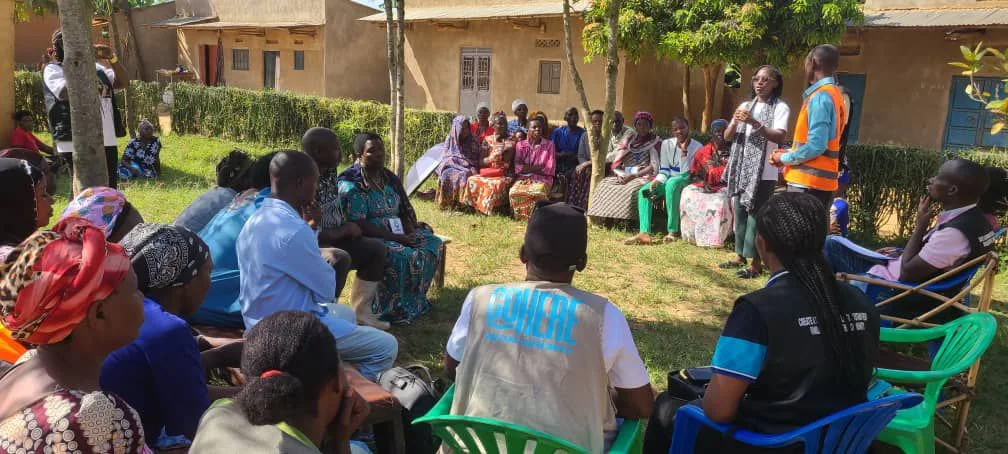
In 2015, Cohere, which was then called Xavier Project, went to Kakuma refugee camp for the first time as part of a consortium delivering ed-tech homework solutions for refugees. The product, designed by an ed-tech company in Nairobi, was a set of homework quizzes on the Kenyan curriculum that ran on basic handsets through USSD push notifications, and the donor had been subsidising it at low cost in Kenyan primary schools before agreeing to fund a rollout into the refugee primary schools of Kakuma. Eleven years on we have partnerships with over thirty refugee-led organisations in Kakuma and have had a full-time presence there ever since, so I do not have regrets about the visit. The project itself, however, was bizarre, and may well have done as much harm as good. There is one story from it that has stayed with me as an illustration of how a technocratic intervention with highly defined outcomes can end up undermining what ought to be the higher humanitarian goals, which is to elevate the agency, dignity and justice of people whose lives have been upturned and who have unfairly lost control over their own futures.
To build an evidence base for the intervention, the ed-tech company insisted we run a randomised controlled trial in three of the fourteen primary schools in Kakuma. We divided each participating class into an intervention group made up of students who had access to a basic mobile phone, who were asked to bring their phones in from home so we could install the homework software. The control group, who did not have phones, were told they would not be getting the opportunity this time round, but that if the trial went well their contribution could help roll the project out across the entire camp, including to them.
A term went by and we monitored the test results the teachers set every month to see whether students using the homework software regularly were improving relative to those who were not. We extrapolated from the number of quizzes each student had completed whether more practice was producing more benefit. Scientifically the trial held too many confounding variables to demonstrate efficacy with any rigour. When we looked at the results we found a great deal of confusing or unexplained data, with impossibly low or impossibly high test scores we put down to marker error or absenteeism, and outliers that did not fit the pattern we hoped the data would produce.
Two students’ results had to be removed from the dataset, students I will call Nyakim and Chuol. Nyakim had been in the control group and Chuol in the intervention group, and their scores had come out similarly enough that the pattern would have stayed invisible to us had a teacher not tipped us off that Nyakim had been accessing a handset at home. She and Chuol lived together, not as brother and sister, as we had guessed from the registration sheet, but as father and daughter.
On one of our subsequent visits to the school, we called Nyakim and Chuol into a separate room with their teacher. The conversation was led by a colleague of mine, who left soon after this project, and by the team from the ed-tech company. The participants in the room found a level of comedic value in the situation, in the fact that Chuol and Nyakim were father and daughter and in the same class, and that they had been sharing the handset together at home in a way that undermined the integrity of the trail. My colleague explained that their results would have to be removed from the dataset, at which the two of them looked disappointed, even though on an individual level the removal would have no effect on them.
What struck me most about that conversation was how the whole situation had degraded Chuol’s dignity. He was a man in his forties, with the traditional scars etched into his face that men of his age from the Nilotic tribes of South Sudan carry, sitting the fifth year of primary school next to his daughter, in the bright pink uniform of Peace Primary School. Their teacher did not seem to treat him any differently from the other students, and found a dark enjoyment of her own in the fact that one of her primary school pupils was older than she was, and was certainly happy to laugh about the situation in front of him. I was struck, sitting in that room, by the irony of an aid system that had decided that what was best for the refugee students of Kakuma was a scalable, broad intervention to improve their marks in the Kenyan primary school examinations. The goal might one day have served Chuol’s dignity by giving him access to a system that required some certification. In real time, in the room with him, it was producing what must have been deep humiliation for him, undermining his sense of his own role in the world.
Chuol, by the narrow material reading, had not been denied benefit. The project, if it worked, would have improved his marks in the Kenyan curriculum exams, and perhaps eventually given him access to the certificates that unlock work. What we had been denying him, in the room where we sat with him, was the ability to influence the decisions that were shaping his life and his daughter’s, and that denial was producing in real time the humiliation the project’s eventual benefits were supposed to redeem.
In addition to being humiliating for Chuol, this problem could be assessed as a missed opportunity, as Chuol and Nyakim were clearly more inventive when left to their own interpretation of a programme than was envisaged by the aid sector. However, beyond being a missed opportunity, the short sighted goals preferred by the system could be argued to be harmful, because the funds raised and the projects implemented implicitly endorse the status quo faced by refugees.. Across three decades, the combined cost of maintaining the two large refugee camps in Kenya – through UN agencies, international NGOs, and bilateral aid – has run into billions of dollars, plausibly in the range of $7-10 billion. Yet despite this sustained investment, and a far-too-shallow commitment to more integration for refugees in Kenya, the underlying structure has remained largely unchanged. The rights of refugees in Kenya, who have in some cases lived there for three decades are still significantly suppressed in comparison to non-refugees. It’s possible to imagine what $7-10 billion could have achieved had even a small portion of that been used to support refugee led advocacy and policy development that would have seen refugees in Kenya access fairer rights.
For example, the homework tool that Chuol and Nyakim were piloting was available to and used by over 1 million Kenyans at a cost of $0.10 per week. If Chuol had had the freedom to move and the freedom to work it is plausible that he would have been able to pay the fee for Nyakim (and himself if he wanted) to use the homework software on their own terms. Instead, the donor and the iNGOs (including Cohere at this time) created a programme that cost more than $0.10 per user per week, funded by the donor, with most of the total cost being absorbed by the NGO sector and by a system that benefits overall from refugee camps continuing to exist. By ploughing more money into this protracted situation (by this time Kakuma had already existed for three decades), the aid system arguably makes it harder to question the bigger structural changes that need to occur. Instead when refugees achieve real self-reliance, they also give themselves more leverage to be able to lobby for improved rights because they can make a stronger case for being net contributors to the hosting country.
“…The central learning of those eleven years has been listening to the people we are working with every day, and what they have told us, again and again, is that humanitarianism should no longer be thought of as aid handouts or the optimisation of outcomes but a question of justice, dignity and agency.”
This is precisely the argument made by Masengesho Mirimo and Mathias Rukira of Tomorrow Vijana, a refugee-led organisation that Cohere has partnered with for more than a decade in Rwamwanja Refugee Settlement in Uganda. In a recent podcast discussion with Cohere, they described how refugees are already contributing far more to Uganda’s economy than is commonly recognised. Refugee-led organisations employ Ugandans alongside refugees, businesses established by refugees pay taxes, refugee-owned enterprises provide veterinary services, agricultural support and vocational training to both refugee and host communities, and local economies have grown around these activities. Their argument is not simply that refugees should be granted more rights because it is morally correct, although they believe that too. Rather, they point out that economic participation creates leverage for advocacy. The more refugees are able to demonstrate that they are net contributors to their host communities, the stronger their case becomes for greater integration, more secure access to land, and a greater voice in the decisions that shape their futures. From their perspective, aid actors often miss this opportunity. Rather than supporting refugee leaders to organise, advocate and negotiate for the rights that would allow them to contribute even more, funding is frequently tied to donor-defined outcomes and short-term projects. In doing so, the humanitarian system risks addressing the symptoms of exclusion while potentially perpetuating the structures that produce that exclusion.
As we enter World Refugee Week, we are sharing the voices of the communities we have come to know across eleven years of working in displacement contexts, in support of the wider argument that humanitarianism needs to be about higher goals than slightly higher marks in the school exams and more completed homework quizzes. The central learning of those eleven years has been listening to the people we are working with every day, and what they have told us, again and again, is that humanitarianism should no longer be thought of as aid handouts or the optimisation of outcomes but a question of justice, dignity and agency.
Listen to the latest episode of our podcast “Are We All Listening?” featuring Tomorrow Vijana’s Mathias Rukira and Masengesho Mirimo here: https://open.spotify.com/episode/5dGIGLwFmH5Gm7rWKDhx3j?si=r_0WIIe1Rvaju-HYFyaK7Q
Leave a Reply