
The message we hear most often from the communities we work with is that the goal is not simply to escape poverty, insecurity or hardship in times of crisis. People seek justice, the dignity that comes from being treated as fully human, and the agency to shape their own futures rather than having them shaped by others. This week during World Refugee Week we are sharing this message. In our campaign “What if we told you…” our partners are issuing a clarion call for change in the way we elevate agency over aid.
These higher goals are irrelevant on their own if they are not available to everyone. If some people are still left out, by design or by default, this is a system or society that is unjust. The most marginalised are by definition the people a framework or system leaves out, so agency without inclusion ends up belonging only to those who can access the system.
When we use the word inclusion in this sense, we mean it without qualification. Anyone can find themselves marginalised at one point or another of our lives, in different ways and for different reasons, so the category of the most marginalised does not need to be fixed on any one group of people with any one set of identifying features. It is enough to accept that inclusion is for everyone, which has to include the people who do not have a physical voice of their own and who communicate the vision they hold for a better future through those closest to them whom they trust. In Cohere’s case inclusion has most typically concerned refugees – people affected by forced displacement whose agency and dignity have been suppressed as a result of the injustices of the world.
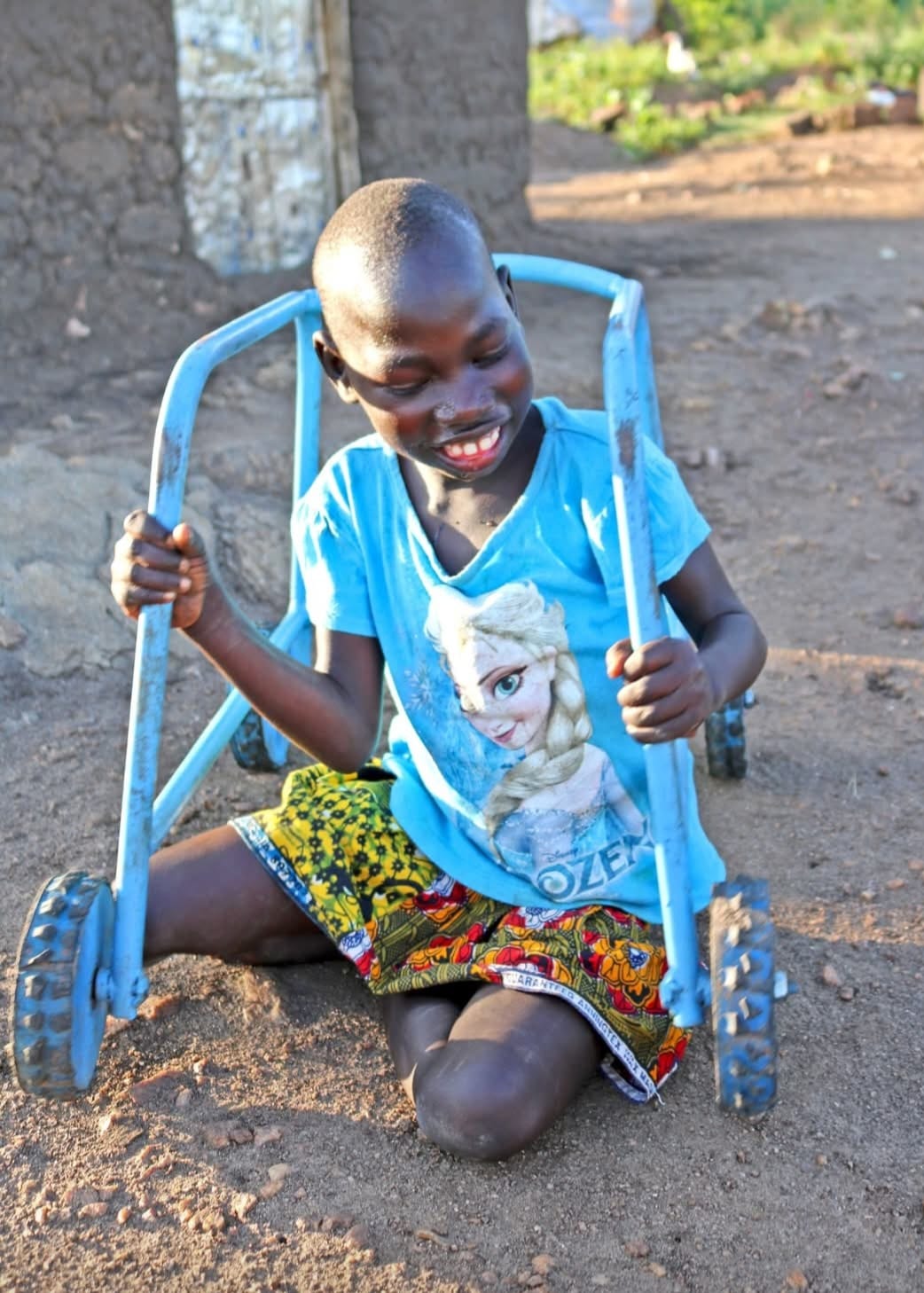
An image of someone left outside the margins to a distressing extent might be a child with severe disabilities living in a refugee settlement in Uganda like Sande Josephine in the image above. She communicates her needs to her mother in ways that may be non-verbal, and her needs and aspirations change from one day to the next in ways that might be unexpected. Despite the prevailing narrative, Josephine has agency. While she is dependent on others to a great extent, she also has power over her life and over her future.
“…the trust-based human relationship, which has to sit alongside agency and inclusion as a necessary part of any just society and of any humanitarian response that aims to be worthy of the name.”
The mother of a child with disabilities would typically be the most highly qualified person to listen to her and to respond to her situation as it evolves, while integrating her needs with her own and with the pressures of looking after the rest of her children. Her family’s needs in turn sit inside the integrated needs of several hundred other families in the same settlement who are looking after children with disabilities of their own.The local community volunteers who have begun to coalesce around those shared needs coordinate responses at the community level that encapsulate the integrated hopes of each family, with broad consensus on how community resources, from finances to volunteer time, can be shared in a way that is appropriate and proportionate.
Trust Based Relationships – the third corner of the triangle
How does an outsider enter this setting? Centring real inclusion changes the paradigm to one led by the most vulnerable, and the community volunteer who at first is an outsider has to be invited into the family before they can access the voice of a child like Josephine, via her parents. Josephine’s agency is communicated through the family and a network of trust based relationships, Now imagine that in the same family there is also a second child suffering trauma from displacement that manifests in much less visible ways, which might lead the parents to parent in ways that at first surprise the community volunteers. Through a trust-based relationship the volunteers can offer their support in ways that are appropriate to the complex and integrated needs of the family, and building that understanding and that trust will take time, in fact so much time that only the community-based volunteers are ever likely to be qualified to do it.
It is understandable that humanitarians would hear about the challenges faced by refugee children with disabilities in Uganda and want to help them. An outsider coming in and skipping the step of building trust, however, is at a high risk of not understanding the needs of this family. It is too easy to imagine a programme that identifies the child with disabilities for support while neglecting to notice that the traumatised child is actually the one not going to school or integrating in the community, and the on-going neglect could exacerbate the second child’s trauma, because he has not been included.
A refugee leader, a Ugandan NGO worker or a foreign visitor each bring something different to the encounter, whether lived experience, cultural familiarity, language or a particular form of empathy shaped by their own life. These differences will influence how trust is built in an appropriate way, but they do not remove the need for trust building no matter how proximate someone is to the family.
The principles of agency and inclusion have been at the centre of Cohere’s work since the beginning. What has evolved over time is our growing realisation that the agency of the most marginalised cannot be expressed through systems, because there is no system, however cleverly it has been designed, that can reach the complex and changing needs of those who are removed from it.
The only approach that can achieve real agency for all is the trust-based human relationship. We only ever achieve things with others, and that happens through real relationships rather than through systematised contracts that try to substitute a procedural interaction for a human one. The same is true of inclusion in its fullest form. It is only through trust-based relationships that the most marginalised can and do communicate their needs and their dreams, in ways that only the people closest to them, the people they trust, are positioned to hear and to carry forward.
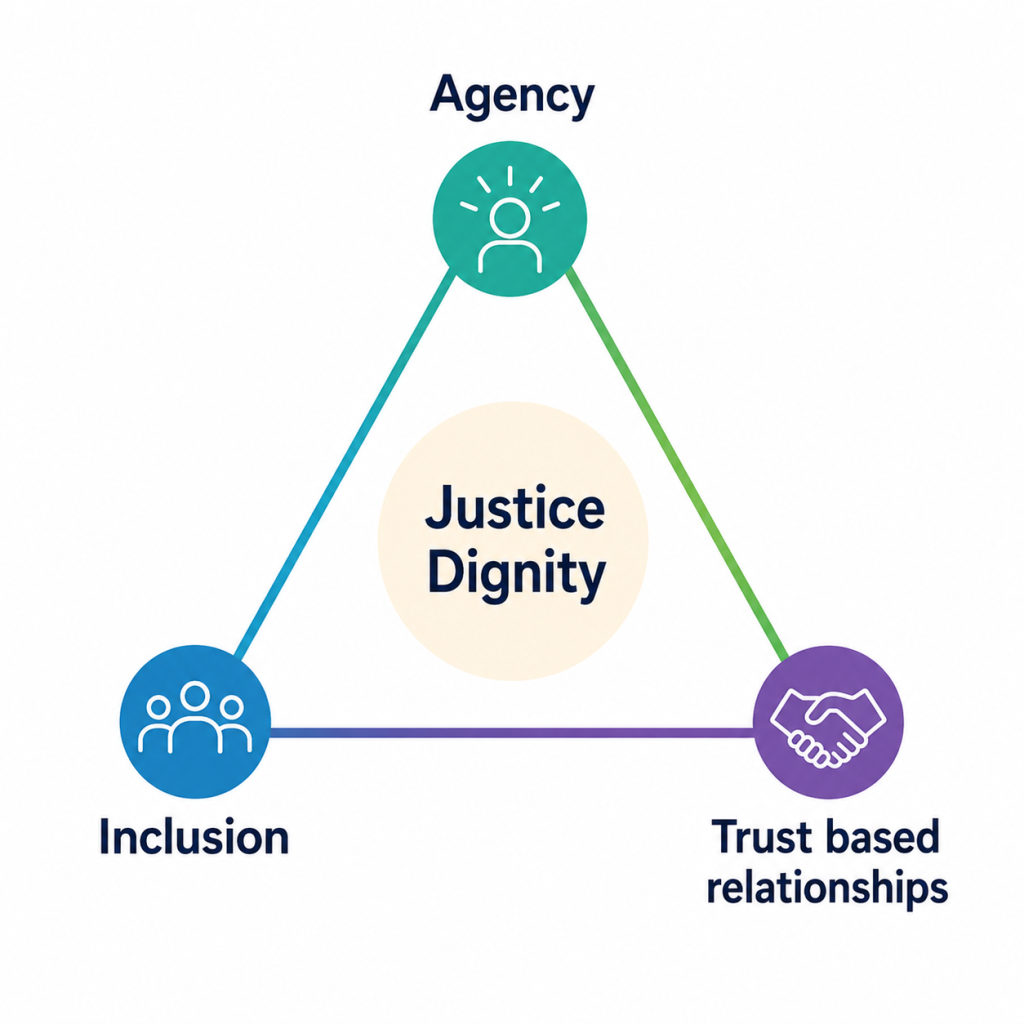
And so the third corner of the triangle is the trust-based human relationship, which has to sit alongside agency and inclusion as a necessary part of any just society and of any humanitarian response that aims to be worthy of the name.
Building trust-based relationships can seem scary to people who are used to operating through systems designed to minimise human interaction. Trust-building can go wrong, and we cannot do it alone, so we have to depend on others in ways the systems we are used to would have shielded us from. But unlike a systems-based approach, everyone can be involved, and it remains our only option if we want to be inclusive and to elevate the higher human goals of agency, dignity and justice.


Leave a Reply