
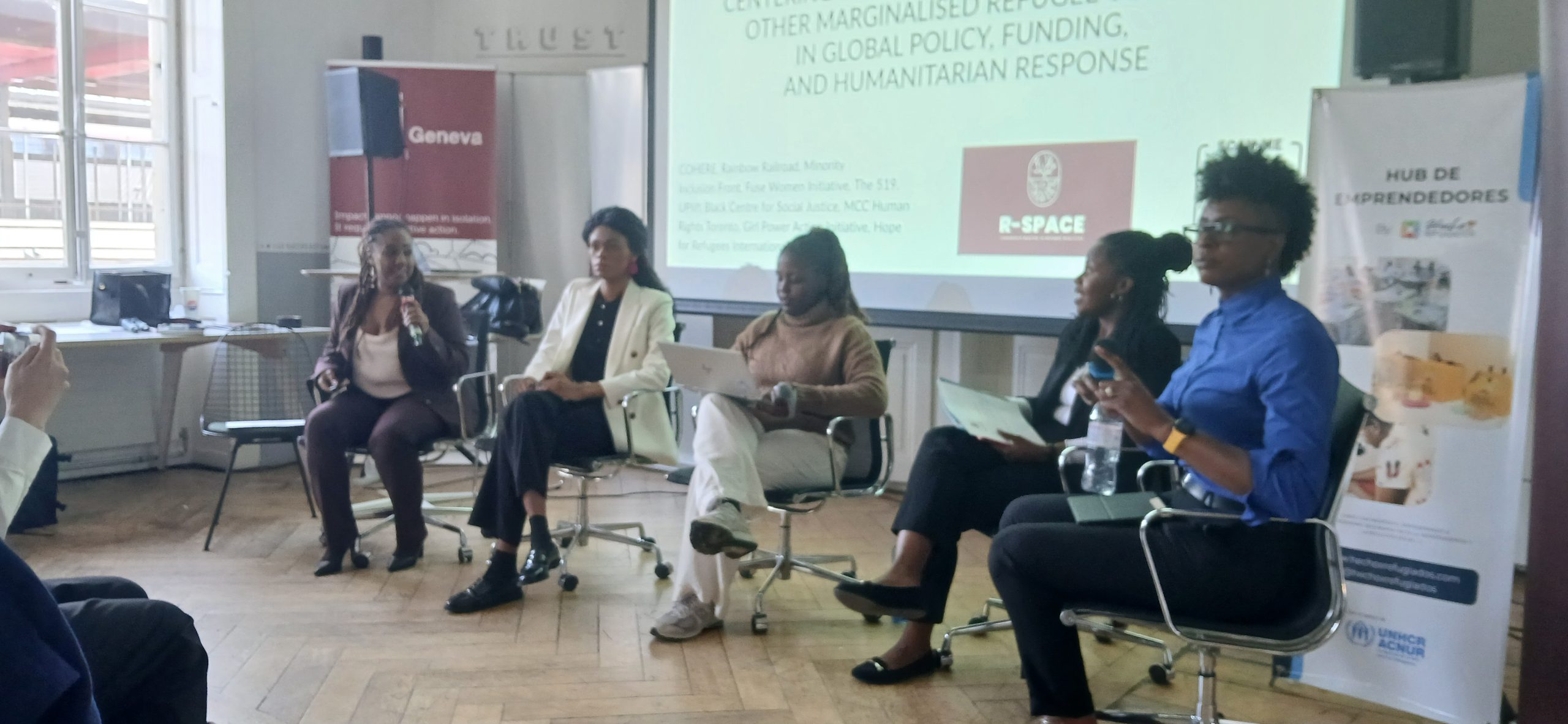
R-Space returning to Geneva alongside the GRF Progress Review came with something the sector rarely gets right; a programme designed around refugee leadership.
Over three days, the space brought together refugee leaders, organisations, and allies across protection, localisation, disability inclusion, climate, economic inclusion, gender, etc and with a clear signal that refugee expertise belongs at the centre of sectoral conversations.
R-Space modelled what meaningful participation can look like when refugees set the agenda – each panel was led by a refugee-led initiative. But those panel discussions also raised a concern, that we as an organisation have been reflecting on for a while, that even when refugee leadership is centred in a space the wider sector conversation still struggles to move beyond funding as the main measurement of success.
ODI/HPG’s findings in their report show that while attention to financing refugee leadership is increasing, funding reaching RLOs remains a “drop in the ocean” compared to mainstream refugee response financing. ODI/HPG estimates around $49m reached RLOs in 2024, compared to $4.7bn channelled through nine UN Refugee Response Plans in the same year.
Many of the conversations I was a part of in Geneva often stayed stuck at “getting funds to RLOs,” without really considering how it was funding, on whose terms, through which systems, and how inclusive was the process of funding itself
Funding can move without Agency
Having been a fiscal intermediary for years, we know that one can fund an RLO and still preserve the same architecture where donors still set the agenda, intermediaries still define eligibility, compliance still runs one way and risk is still interpreted through the assumption that funding refugee leaders directly is inherently riskier.
ODI’s data also exposes a bias within the sector that equates “scale” with legitimacy. Average RLO grants remain far smaller than what UN agencies receive, and the implied message is not only that RLOs cannot be trusted with larger grants but that small grants cannot be catalytic. At Cohere we know that catalytic funding is not just about size but about proximity and what becomes possible when communities can lead without being squeezed into compliance-heavy, short-term funding.
” The fact is, the sector is obsessed with looking at things through formal structures and scale and as a result it cannot recognise or value proximate leadership because it rarely meets institutional standards of ‘credibility.’ “
In Rwamwanja, my colleagues met a couple in Kasisa who turned their sitting room into a free tailoring training space for vulnerable teenage girls. They responded to what they witnessed within their community and did so without a grant or any formal structure. They trained cohorts for free, encouraged trainees to sell what they produced to earn, and even after graduating young people kept returning every Saturday because the couple let them use their sewing machine when they still couldn’t afford their own. This couple haven’t registered as a CBO because the cost is too high, they said ‘better to buy sugarcane for trainees lunch than pay for papers’.
The fact is, the sector is obsessed with looking at things through formal structures and scale and as a result it cannot recognise or value proximate leadership because it rarely meets institutional standards of “credibility.”
Why the inclusion lens is still missing
Over the course of the week, Cohere spoke on a few panels and one focused on inclusion of the most marginalised refugee leaders, the people routinely pushed furthest from decision-making: women, youth, persons with disabilities, Black and racialised LGBTQI+ refugees, and others facing multiple exclusion.
During our discussion we tried to pinpoint what the wider conversation often avoids: who is actually being included when the sector says “meaningful participation and refugee leadership”
This is why the emphasis on “getting funds to RLOs” needs needs to consider inclusion more broadly. Direct funding can still create exclusion.
Co-design is a flawed concept
There were a lot of conversations that focused on co-design and how it is making the funding streams inclusive, but co-design is not a pathway to inclusion. It can be a method inside an unchanged system that translates community priorities into donor language or pre-approved agendas set at the top, basically a palatable version of the same power imbalance.
There were many conversations that inclined to seeking compromise and meeting donors where they are. The fact is that many of the larger donors have not convincingly proven that their wider strategies are really centred on the most marginalised, as opposed to using aid as a tool for holding power and managing reputational risk. So what gets described as “compromise through mechanisms like codesign” can easily become something else such as a soft acceptance of the same gatekeeping and the inevitably the same harmful practices, just with refugees present in the room to endorse it.
Localisation loop is still intact
However, what was most unfortunate was that still a lot of conversations brought up the underlying storyline that RLOs need to prove how much more effective they are at doing their work and therefore should receive more direct funding.
To us this is not a new concept, it is the same localisation loop we have lived with since the Grand Bargain where capability and capacity are measured as the entry test in order for local actors to earn trust in return.
It is also a convenient logic because it keeps the burden on RLOs to keep proving their legitimacy, over and over, instead of forcing the sector to confront its own blind spots and dismantle the structures that keep them out in the first place.
ODI’s data showed that in 2024, public donors reportedly provided only a very small share of direct support to RLOs, even as the system continues to talk about “localisation” as a priority.
Donor and Sector constraints were not interrogated hard enough
The conversations did not go far into how each of the specific constraints that institutional and government donors operate under such as legal mandates, audit rules, public and political scrutiny can be changed and how to stop those constraints being used as a permanent excuse. There was too much acceptance of “we are not yet ready” and not enough focus on what redesign they need to become ready.
Due diligence and compliance burdens are still barriers
Another clear gap in the Geneva conversations was the lack of serious commitment to reforming rigid due diligence and compliance burdens.
The sector often justifies this bureaucracy using familiar arguments such as taxpayer accountability, safeguarding, fraud prevention, but the current approach to due diligence and the perception of risk is not solving them but sustaining the status quo.
That is what our position paper on Trust Building & Due Diligence documents that paperwork has become a proxy for trust, and it functions as surveillance with excessive reporting and relentless audits that consumes time and resources.
As one refugee leader told us: “Most due diligence processes don’t help you understand the organisation. They just force us to create documents that look like what donors want. It’s control, not trust.”
As a result, credibility becomes directly proportionate to leaders who speak fluent English, hold formal registrations, and produce polished reports are elevated as “safe”, while many proximate leaders with deeper community legitimacy and trust are sidelined.
To conclude, I didn’t leave Geneva feeling more cynical but I left gaining even more clarity. The wider sector still seems determined to solve localisation through funding flows and participation methods, while avoiding the core issue: agency and inclusion as a structural practice.
If we do not dismantle the mechanics of exclusion such as rigid due diligence, compliance burdens, one-directional risk logic, and the assumption that refugee leadership must be managed before it is trusted, we will replicate the same mistakes.


Leave a Reply