
“…solutions emerge when we lean in, listen carefully, and co-create with communities. Farmers already know what works and what is possible—they just need space, trust, and support to scale it.”
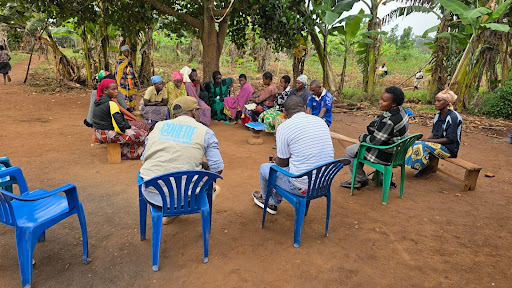
In January, I had, what I can honestly call, the most interesting “conference” I have attended for a very long time. This time it was not in a city boardroom, but in the farmers’ own compound, under the shade of an avocado tree in Nkoma zone, Rwamwanja Refugee Settlement (Uganda). Surrounded by their gardens, tools, and livelihoods, we met people on the shamba – where they work and live. It was the antithesis to the usual agricultural conference which gathers a handful of representatives to a hotel in Kampala – Uganda’s capital city.
The key theme of the day was simple but powerful:
How is the partnership between Cohere, the social enterprise Turaco Valley Foods, the refugee-led organisation Tomorrow Vijana, and the farmers working to improve the maize value chain in Rwamwanja, and what more can be done to strengthen it?
The feedback was candid:
- One farmer highlighted better seed varieties:
“Last season, the seeds arrived late, but this time we’ve kept our seeds and won’t experience that again. Instead, let’s invest in post-harvest handling materials.”
- Another woman, the team leader, proudly displayed receipts showing that everyone in the group had sold maize to Turaco and received cash. When asked about prices, they all smiled and said, in unison:
“This is the highest price we have received this season compared to any other buyers outside here.”
As the conversation unfolded, farmers raised a related challenge: maintaining good maize harvests amid declining soil fertility.
“Our gardens need fertilizers because the soils are becoming infertile,” one woman explained.
We explored local approaches they had seen others use. Some bought inorganic fertilisers, while others relied on compost or animal manure. A colleague from Tomorrow Vijana expressed his worry that inorganic fertilisers can be costly and even harmful to the soil, highlighting the value of sustainable, locally available approaches. And regarding use of organic manure, only one woman had consistently practiced household composting, while the others admitted they had not prioritised it. On animal manure, many thought it was too expensive or difficult to access animals.
That is when we discussed small-scale sheep rearing. Sheep are low-maintenance, require minimal space, and quickly generate organic manure—a traditional practice already familiar in nearby host communities. We explored what it would take for each household to start with one sheep, and the women concluded it was entirely feasible—purchasing one after selling maize in the next harvest season to Turaco Valley Foods.
By the end of our discussions, the group agreed that:
- Household composting would be prioritised.
- Each household would plan to rear a sheep for manure.
- Income from maize sales would fund this next step.
Why This Worked
This “conference in the field” was made possible by a web of trust-based collaboration—with Tomorrow Vijana, a refugee-led organisation, connecting directly with refugee farmer groups, providing them with agronomic skills, better maize seed varieties, post-harvest handling equipment and on-going extension services; Cohere supporting systems, learning, and resource mobilisation; and Turaco Valley Foods linking farmers to a reliable market at their maize milling plant in Rwamwanja, through fair pricing and cash payments for maize grain. Rather than delivering pre-packaged solutions, this ecosystem enabled knowledge, resources, and market access to flow horizontally, shaped by farmer priorities and grounded in real-time feedback from the field.
My biggest takeaway from this “conference in the field” was clear: solutions emerge when we lean in, listen carefully, and co-create with communities. Farmers already know what works and what is possible—they just need space, trust, and support to scale it.
Reflection for Donors and Practitioners
- In 2026, are we going to spend enough time with frontline communities, meeting them where they are, to understand what solutions they truly need? Are we really listening to them?
- How often do we intend to co-create interventions in the field, rather than designing them from afar?
I think these are questions worth asking as we think about sustainable, trust-based impact in the year ahead. There is so much to be reaped through listening and engaging in this way.
Leave a Reply