
The UN Chief, António Guterres, has warned that due to imminent financial collapse, the UN as we know it could implode.
“Fifty years on, the UN continues to ask how it can remain relevant to people living in contexts of oppression and displacement. Yet the questions it poses often reveal a narrow understanding of what relevance means”
The UN as we know it consists of 193 member states coordinating 28 separate organisations, employing well over 100,000 staff. Of these, the majority are employed to work on in-country programmes designed to alleviate suffering and lift marginalised populations out of poverty. UNHCR, for example, now employs around 20,000 staff and operates country programmes in 138 countries, weighted towards contexts most affected by forced displacement. In comparison, in 1974—just a decade after the independence of most formerly colonised countries and some thirty years after the founding of the UN—the entire UN system employed no more than around 20,000 staff. UNHCR at that time was a comparatively small office, managing a global assistance budget of under US$20 million (versus $8 billion today), focused primarily on international protection, coordination, and time-bound assistance aimed at durable solutions such as voluntary repatriation, local integration, and resettlement. It was not yet a mass delivery system, nor an organisation structured around long-term country programmes or permanent refugee management, but one that was explicitly oriented towards advocacy.
Guterres might remember this era, because 1974 was the year he began his political career in Portugal, culminating in the ultimate responsibility of being the uniter of nations today.
Fifty years on, the UN continues to ask how it can remain relevant to people living in contexts of oppression and displacement. Yet the questions it poses often reveal a narrow understanding of what relevance means. Refugees in East Africa are commonly asked whether they would prefer more or less assistance, or greater or lesser degrees of safety. These questions are so self-evident that they are rarely intended to invite genuine deliberation; they function rhetorically, with the answers assumed in advance.
What is far less often asked is whether people are willing to accept material support at the cost of agency, or safety at the expense of self-sovereignty. When these questions are posed—explicitly or implicitly—the response I hear most frequently is that material benefit is not worth the loss of control over one’s own life. For most people, in most circumstances, the freedom to make meaningful decisions appears to matter more than freedom from poverty or other forms of suffering alone. This is not a formal finding, but an observation drawn from decades of conversations in which these tensions repeatedly surface.
I think the reason people from the global north struggle to understand this is that those of us who have grown up in liberal democracies as citizens have a deep subconscious sense that we contribute in a small way to collective decisions. There is no authority or institution that can fully replace our agency and claim to do what is right for us without us having any say in the matter. Politicians, law enforcement, institutions – they work for us. If a new law seems to impede our agency, such as being required to wear a seat belt, we accept that someone we voted for thinks it’s a good idea.
“Citizens in far away countries, who have never been to or even heard of the region, have power over the lives of refugees in East Africa through their implicit endorsement of their state donor agencies and the multilateral institutions of the UN”
For refugees in East Africa, this dignity is taken away, not only because they have no political rights in the country that hosts them, but also because they are used as pawns in a huge global game of geopolitics. Citizens in far away countries, who have never been to or even heard of the region, have power over the lives of refugees in East Africa through their implicit endorsement of their state donor agencies and the multilateral institutions of the UN. These agencies hold the final say in refugee hosting contexts by footing the bill that perpetuates the conditions they face. In many cases, they not only pay the bills, but they configure the conditions refugees will experience, signing off on a list of usual freedoms refugees will be restricted from. An example of this was the deal struck between European governments and Turkey to prevent refugees fleeing to Europe, by paying for their restricted existence in middle eastern camps.
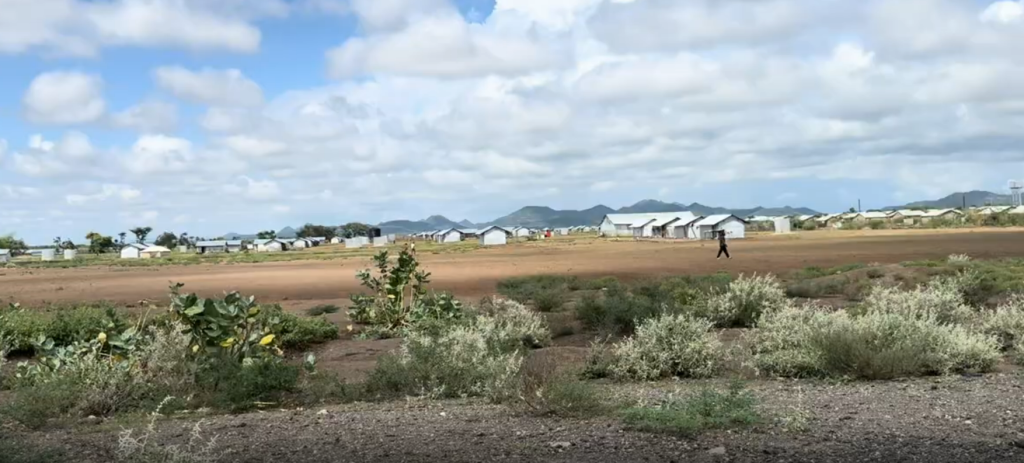
A shot from Kakuma Refugee Camp in Kenya
In Kenya, western governments endorsed and paid for policies that reduced freedoms for refugees in return for Kenya supporting the war against Islamic extremism.
The same people are then surprised when refugees don’t seem grateful for the aid they receive once all their rights have been curtailed.
For people who have grown up with agency over their own governance in globally dominant nations, meaningful communication with refugees is shaped by asymmetries of experience. Not having had the right of agency taken away from us, we cannot fully understand what it is like to lack it. We too easily project that refugees will want safety and freedom from poverty because these are challenges that we can more easily understand and we assume that if we were in this position this is what we would want.
“Ever-growing country programmes have shifted the UN’s centre of gravity away from advocacy and towards the long-term management of systems that perpetuate rather than mitigate suffering, trading sovereignty for top-down interventions labelled as “protection” and “assistance”
Over the last eighty years, leaders and policy makers at the United Nations have collectively misunderstood this point with increasing hubris. Ever-growing country programmes have shifted the UN’s centre of gravity away from advocacy and towards the long-term management of systems that perpetuate rather than mitigate suffering, trading sovereignty for top-down interventions labelled as “protection” and “assistance”.
A UN centred around sovereignty, on the other hand, would focus on including and strengthening the agency of states and citizens who have been historically oppressed and who continue to be marginalised today. It would speak up for its members on issues that affect everyone:
- coordinating global action to prevent climate catastrophe and pushing for fairness in how climate impacts fall disproportionately on the Global South;
- working towards nuclear disarmament to reduce the risk of global annihilation and challenging the profit-driven nature of the arms trade;
- promoting fairer trade by confronting extractive practices, tax havens, and economic systems that disadvantage weaker states;
- advocating for fairer movement of people, including refugees, so that freedom of movement is not determined by the accident of which passport someone holds, but by shared responsibility and human dignity.
If the UN were to take this kind of advocacy seriously, uncomfortable questions follow. Would we still need vast, long-term refugee camps run by UNHCR? Would we require such expansive programmes delivered by UNDP, UNICEF, or FAO? Would agencies like UNAIDS, UN-Habitat, UN Women, WFP, or even the IFC be needed at the scale we see today? Perhaps the most troubling possibility is that strong advocacy is sometimes avoided precisely because it could threaten the financial and political foundations of these country programmes themselves.
The UN is therefore complicit in a system that services greed, reinforces inequality, and perpetuates the colonisation of the oppressed -just as its most powerful member states who continue to use aid as an afterthought to advancing self-interest and geostrategic power.
Let’s see how it all unfolds when the money isn’t there.
Leave a Reply